


Brutalism in Slovakia: A Lecture by Henrieta Moravčíková at the Walter Rózsi Villa

On May 20, 2026, as part of the accompanying events for our exhibition on Brutalist architecture, architectural historian Henrieta Moravčíková gave a lecture on Slovak Brutalism at the Walter Rózsi Villa.
Henrieta Moravčíková is a senior researcher at the Slovak Academy of Sciences, a professor at the Technical University of Bratislava, and the president of Slovak DOCOMOMO. Since 2019, she has served as editor-in-chief of Architektúra & Urbanizmus, a Bratislava-based publication considered one of the region’s most important architecture history forums. Her professional career is marked by numerous studies and volumes on 20th-century Slovak and Czechoslovak architecture; she also leads pioneering research, unique in the region, on the typological analysis of the architectural heritage from after 1945.

In his lecture titled “Slovak Variant of Brutalism?”, the professor analyzed Slovak architecture of the second half of the 20th century by refining and expanding upon the architectural-historical framework established by Tomáš Štrauss. Štrauss’s conceptual system—conceptual thinking, symbolic forms, and the use of geometric volumes—characterizes a truly unique group of monuments, one in which, however, exceptions are just as characteristic as variations.
The lecture addressed the trend associated with the name of Ivan Matušík, which worked with stereometric masses and strove for a monumental effect, as well as the visions of the VAL creative group (Alex Mlynarčík, Viera Mecková, Ladislav Kupkovič)—whose visions still seem astonishing today, yet which, according to the artists’ own conception, were realistic and could have been realized. Of course, the selection could not have omitted Vladimír Dedeček and his now world-famous works, such as the extension of the Slovak National Gallery or the National Archives in Bratislava, nor the building of Radio Bratislava designed by Štefan Svetko, Štefan Ďurkovič, and Barnabáš Kissling (1962–1984).
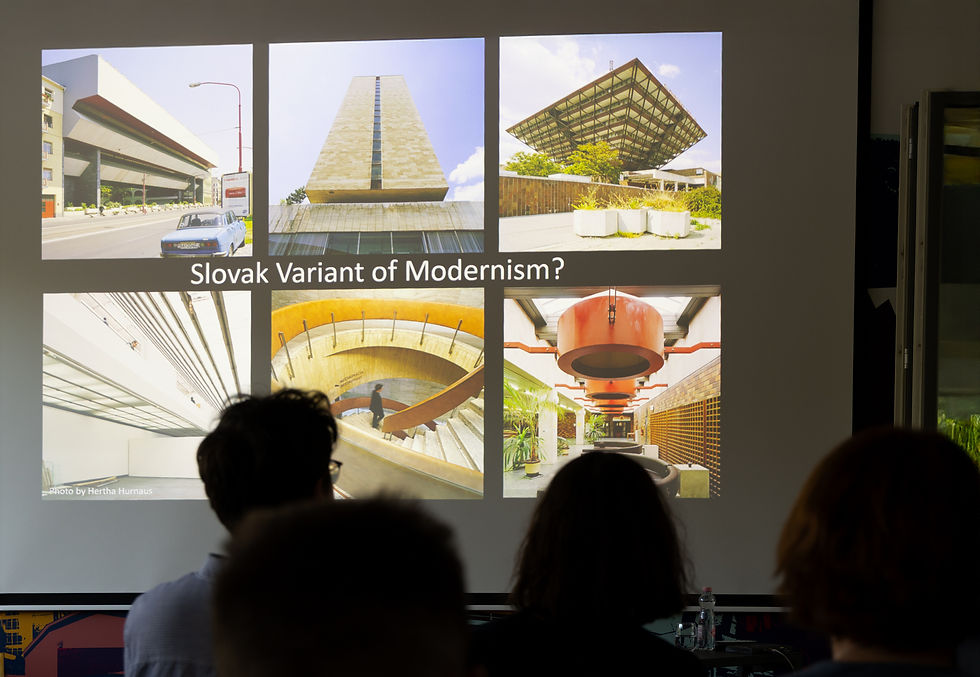
In addition to these well-known icons, Moravčíková presented numerous lesser-known but exceptionally exciting and high-quality buildings, such as Ferdinand Milučký’s residential building in Bratislava (1970–1975), which, in addition to its brutalist use of materials, also reflects the influence of vernacular architecture, or the Koliba restaurant building (Vojtech Vilhan, Stanislav Talaš), relocated to Bratislava after the 1967 World’s Fair.
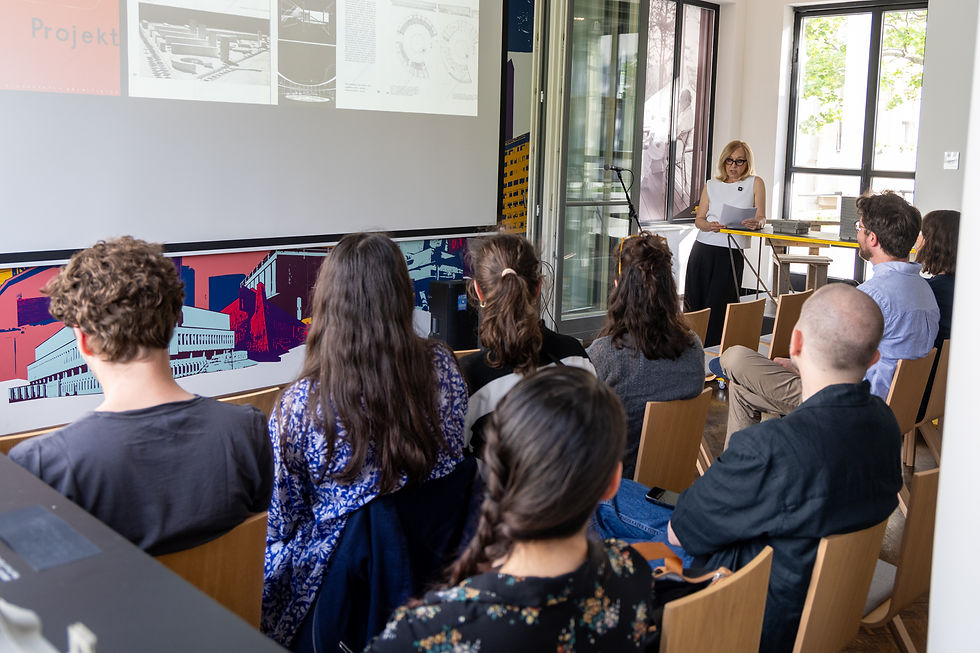
The lecture revealed a form of Brutalism that differs significantly from that in Hungary, one with much stronger roots and a deeper sense of locality, and which still enjoys greater social support in Slovakia today than buildings from the same era do in Hungary. Accordingly, in addition to the demolitions cited as sad examples, the professor was also able to report on positive examples of major restorations and extensions.
A video recording of the lecture was made, which we will make available to those interested on the HMA MPDC (MÉM MDK) YouTube page.
Dániel Kovács
Photo: Róbert Hack, MÉM MDK
Our exhibition on Hungarian Brutalism, titled “Breuer, Goldfinger, and Other Magyars. Brutalist Architecture in and out of Hungary,” is on view at the Walter Rózsi Villa through December 20, 2026.
Comments